
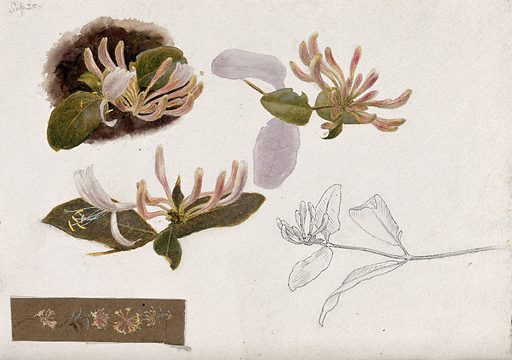
Richard Gipps is a philosopher and clinical psychologist based in Oxford, UK. In his article published in Philosophy, Psychiatry, & Psychology, he discusses the relationship between living faith and the experiences of mental and physical illness, deprivation, and bereavement.
A “honeysuckle on a broken fence”: Scrutton’s (2024) theologically potent image offers us a dignified vision of how a living faith and the experience of mental illness might intersect. Mental and physical illness, deprivation and bereavement sometimes provide a propitious structure on which faith’s bright strands may grow. Scrutton posits no simply causal relationship between faith and mental illness, and steers us helpfully away from the narcissistic overvaluation of inner experience too often met with in (1) mysterium tremendum (meeting-God-blew-my-mind), and (3) mental openness (divine-light-pours-through-the-cracks), formulations. She helps us to avoid settling, too, for the clever-sounding but ultimately too-easy idea of (2) ‘mental illness’ and ‘religious experience’ as different descriptions under which identical experiences may sometimes be brought. For one thing, and to animadvert now in my own vein: can we really—as William James aspires to, say, when he takes it for granted that the “more personal branch [of] feelings, acts, and experiences of individual men in their solitude, so far as they apprehend themselves to stand in relation to . . . the divine” can be neatly hived off from the “institutional branch of religion . . . worship . . . theology . . . ceremony . . . ” and so on—even individuate the relevant experiential phenomena independently of their meaning-conferring contexts? For another, it seems to me that too often in the literature of (1) (2) and (3) do we meet with a fatal confusion that can be expressed in terms of a conflation of two meanings of “ego,” as when a) the dropping of the kinds of boundaries which it makes sense to talk of putting up (i.e., our ego’s defensive, prideful, shame-driven shirking of intimacy) is muddled together with b) the crumbling of such individuating ego boundaries as constitute us. Such a confusion gets readily promulgated by vague and tacitly polysemic talk not only of ‘ego’ but also of ‘non-duality,’ ’transpersonal,’ and ‘higher’ and ‘lower’ ‘levels’ of ‘self’ and ‘consciousness’ (e.g., see Kasprow & Scotton 1999). Sometimes driving this, one can’t help suspect, is the narcissistic gain of conflating the dismal dissolution of ego boundaries in illness (Conrad, 1958) with the epiphanic transcendence of a grasping and fearful ego. Spiritual pride and spiritual bypass (i.e. fleeing the relational tasks of adult development into a self-preoccupied ‘spiritualised’ inner journey) (Welwood, 2000) then abound, not only for the sufferer but also for the lowly therapist who now receives their shamanic guide/hierophant upgrade. By contrast with all of this, Scrutton’s (4) honeysuckle on a broken fence model stands out in its theological dignity and psychological sobriety. […]

 Center for Metanoia Studies (Centre d'Etudes Interdisciplinaires de la Métanoïa)
Leave a comment